Open Source will win in the AI Age

An opinionated answer to what open source becomes once the AI writes the code: how it will grow in importance as the caching layer for technological breakthroughs, and why a sea of solo open source developers with superior taste will out-innovate their closed counterparts.
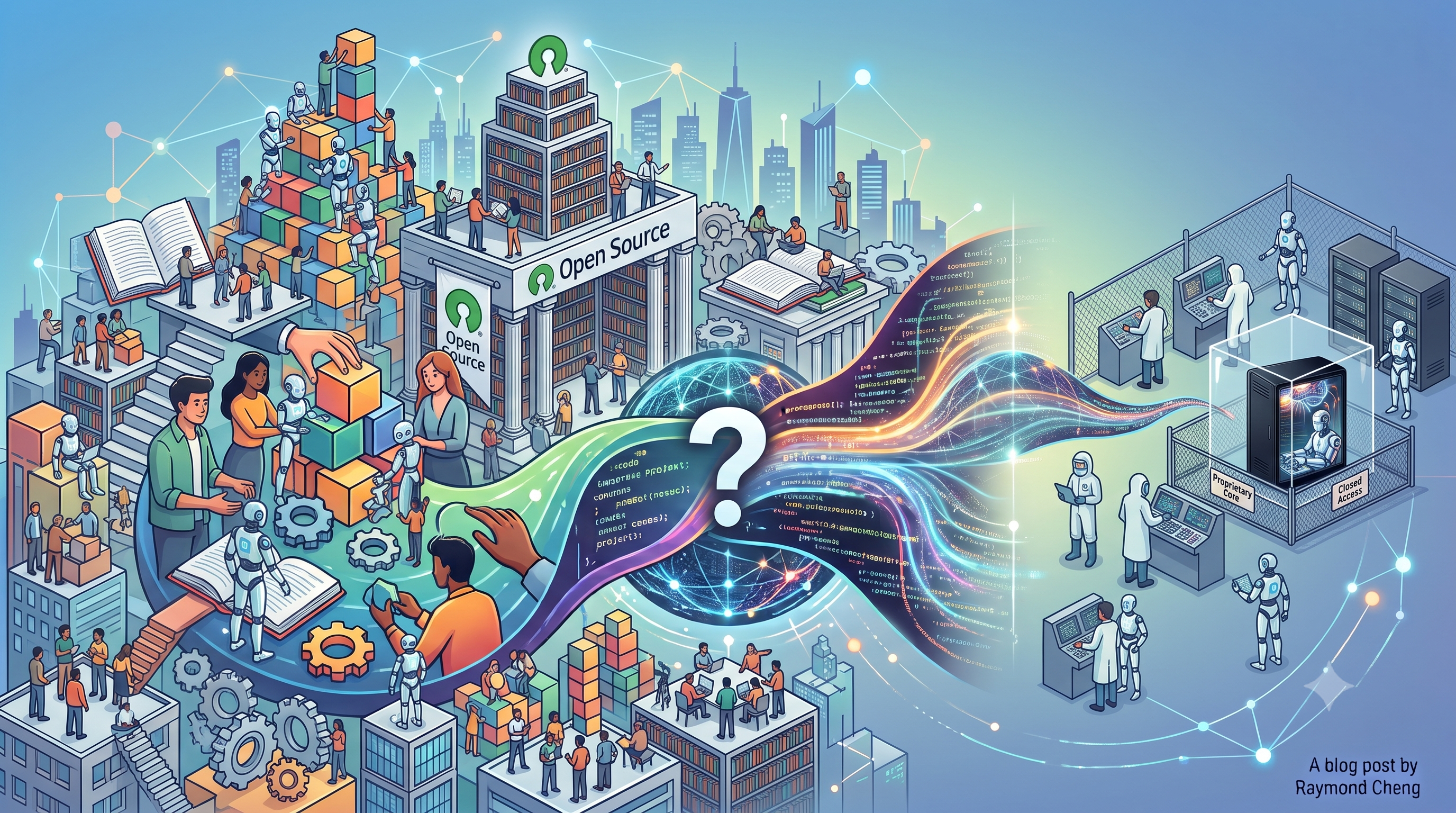
What is open source once AI writes the code?
AI agents already write a growing fraction of the code in production codebases, and that share only climbs. So the question sounds almost rhetorical: if a model can generate any library you need on demand, why do we even need open source libraries anymore?
That intuition is wrong. Writing code was the expensive part. When it gets cheap, the bottleneck moves. The hard question is no longer can we build it but what is worth building, and how do we avoid everyone rebuilding the same thing. That is what open source is for, and it matters more in the AI age.
My answer has two parts. They are different arguments, but they reach the same conclusion: open source out-innovates closed.
The first is depth. A single developer with great taste, armed with AI, will out-build entire teams. In the medium term, taste is the scarce input, and the people who have it will produce more and better software than everyone else.
The second is breadth. Open source is how society caches its progress. Every published library is a solved subproblem nobody has to solve again. In the long run, as software teams go autonomous, that shared cache is the only thing that lets exploration compound instead of being repeated in isolation.
(I've made the parallel argument for data elsewhere; here I'll focus on software.)

Depth: the super-powered maintainer
Give everyone the same coding agents, and taste becomes the only thing that separates them. A single developer with great taste will build a hundred great libraries. A hundred developers with average taste will build a hundred mediocre ones. Same tools, wildly different output.
When generating code is cheap, code is no longer the scarce input. Judgment is. Knowing what to build, what good looks like, and which of a thousand generated variations is worth publishing is the constraint. That judgment is taste, and no agent supplies it.
We can already see it today. Sindre Sorhus, one developer, maintains over 1,000 npm packages that millions of projects depend on, and he did it before agents could carry the plumbing. Automate the boilerplate, the tests, the release chores, and the triage, and the ceiling for one person with taste rises sharply.
Picture a small number of developers with exceptional taste, each running an army of agents, trading ideas and setting the direction of whole ecosystems. Fewer hands, far more leverage, better libraries.
Who pays these people is a real question, and I've written separately about funding the maintainers everything depends on. The point here is simpler:
The super-powered maintainer is coming, and taste is the superpower.
Breadth: how society caches its search for what works
Open source is a cache. Publishing a working library caches a solved subproblem so nobody, anywhere, has to solve it again. The global commons of open source is society's stored answer to what works.
Without that cache, every developer re-solves the same problems alone: the same bugs, the same incompatibilities, the same edge cases. Open source lets the whole world explore in parallel and keep the wins. Taste, the depth argument, is what keeps that search from being a blind, wasteful crawl.
Caching wins for a durable economic reason, and it holds even as AI gets cheap. The cost of producing software is falling fast, but it never reaches zero, because model inference has a real, recurring cost. As long as storing a result is cheaper than recomputing it, caching pays.
Coding agents already do what any good engineer does: they install an existing dependency instead of re-deriving or vendoring the code. The prompt is the easy part; the hard part is knowing which package is battle-tested, which one holds up across real use cases and deployments. That is what the cache stores: not raw code, which is now cheap, but proven code. The result is a surge in open-source library installs.
 Combined monthly npm downloads for ten ubiquitous packages (react, typescript, express, axios, and others). Source: npm registry download API
Install volume for a basket of ten ubiquitous packages is up 69% year over year, steepest in 2026. One caveat: raw download counts include CI and automation, so this is install activity, not distinct developers, and attributing the rise to agents is my read, not proof. The direction is not in doubt.
Now extrapolate. When software teams go fully autonomous, the volume of exploration explodes, and an open cache of what works is the only way those discoveries compound across the world instead of staying locked behind closed doors.
Open source out-innovates closed
As software gets cheaper, open becomes the default
A second force pushes the same way, and it comes from the market rather than the technology.
As software gets cheap to produce, people are predicting the death of SaaS, a "SaaSpocalypse." When a coding agent can rebuild your tool in a weekend, buyers stop paying rent for it. a16z ran an episode asking whether SaaS is dead in a world of AI, noting that "SaaS switching costs are actually going down thanks to coding agents," and the headlines are already declaring the collapse.
When software is cheap to produce and easy to substitute, its price falls toward its cost, and tolerance for lock-in drops with it. Rent-seeking gets harder.
That changes the release decision. If software is hard to monetize anyway, keeping it closed buys you almost nothing. A proprietary license just guards a shrinking rent. The rational move is to release in the open and capture reputation, distribution, and contributions instead.
Falling production cost does not threaten open source. It feeds it. The same force that ends easy SaaS rents pushes more code into the commons.
This is a directional prediction, not a law. Monetization does not vanish. Support, hosting, proprietary data, and real value-added services still command a price. But for the vast middle of software, the default tilts open.
Why open ecosystems out-innovate closed ones
Combine the two mechanisms, super-powered maintainers and a shared cache, and the conclusion is hard to avoid.
No closed organization out-innovates the entire world working in parallel and keeping every result.
Modern AI is its own proof point. The technology now writing our code was built in the open. The Transformer, the architecture under every frontier model, was published as an open paper in 2017. The labs now racing to build closed models grew out of a culture that shared its core ideas freely, on arXiv and at conferences.
The result is recursive. AI is both a product of open out-innovating closed, and the tool that accelerates the next round. Open ideas built the thing now supercharging open source, and that opening has only started.
The bet: the best models stay universally available
I would be naive if I ignored the big assumption that holds up everything above.
It works only if the best models stay universally available. Open source out-innovates closed only while the most capable models stay within reach of the people and agents building on them. Wall them off, and the open ecosystem loses a powerful engine.
So far the frontier has stayed reachable. Closed labs expose their best models through APIs. The best coding agents that are used to accelerate frontier lab development, are also accessible to anyone with a subscription. Open-weight models track close behind, partly through distillation: training a smaller model on a larger one's outputs. OpenAI has accused DeepSeek of doing exactly this to catch up. Its plausibility shows how hard the frontier is to seal. AI is its own precedent: the field moves fastest when research flowed freely.
The systemic risk is that frontier capability becomes closed, concentrated, and accessible to a small group, and far beyond the open counterparts, choking open development. Imagine a singular proprietary superintelligence that only sells finished products, but better than every other company in the world. Conceivable, but not the world I want to live in.
An invitation
Open source will win in the AI age. It is how the world caches and compounds its search for better software: driven in the medium term by developers with superior taste, and in the long term by the need to share what autonomous systems discover. If the best models stay open, no closed ecosystem keeps up.
It's a still a bet on a future that has not arrived, but I'd put money on it. I could be wrong, but publishing the thought process so better ones can build on it is the most open-source thing I can do.